

You Have Got To Be Fit If You Want To Survive

3 Powerful Tactical Fitness Strategies
You can have all of the gear and food possible to survive shortages, disasters, or wars, but if you are not fit or strong enough to carry your gear, set-up your camp, or hike to your shelter, then you won’t make it. So, you need to be fit.

Now let’s be less dramatic. In the event something happens to one of your children, your spouse, or a good friend, and you have to move them from the accident site to a place of safety, could you do it? Could you carry your spouse up a flight of stairs, or outside to your car to go to the hospital? If not, then you need to get fit.
How about another non-disaster situation – one where you or a family member is accosted. Do you, your spouse, or your children, have the strength or the skills to avoid harm or to flee to safety? Again, if not, then you need to begin getting in shape now.
Now consider floods, hurricanes, fires, or even high winds that blow trees over, do you have an evacuation plan and are you able to carry it out? Could you get your family – or yourself – to safety? If you can’t walk a mile carrying a child, a backpack, or household supplies, then you are not in shape. Your goal is to be able to have the strength and stamina needed to help yourself, your family, or your friends, in any of the survival situations mentioned above. So, let’s start right now with the following tactical plan.
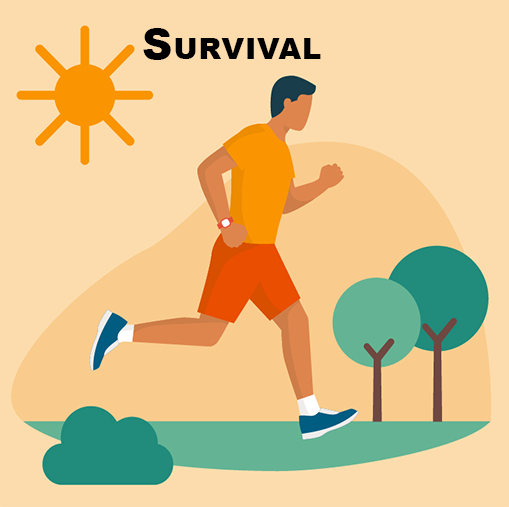
First you will need to train with weights. You need to develop your legs, lungs, back, arms and shoulders so you can carry people, equipment, or supplies, to safety. You will start with walking. You must ultimately be able to walk long distances with weight on your shoulders. So put on your exercise clothes, grab a backpack, and fill it with weights.
Start slowly. If you are not a walker, add up to 20 pounds of weight to your backpack, and try to walk 1-2 miles. If this is achievable, do it 3-5 times each week, taking a day in between walks to recoup.
In survival mode you will be squatting a lot – to pick something up, rest, read a map or compass, drink or snack. You won’t always be able to stop and take off your backpack – or your bug out bag – so practice squatting with your backpack on. As you walk, stop every few minutes and do 5 squats.
Then add more weight and more distance until you can walk 5+ miles comfortably carrying 60-80 pounds of weight in your backpack. Also, increase the number of squats as you increase the amount of weight in your bag, and add a few lunges as you break for those squats.
Also work your arms and shoulders as you do your training walks. Take off you backpack and carry it in your arms as you would carry a tired or injured person. Carry the pack until you feel the burn in your biceps. You should also vary the arm routine by carrying the pack in your hand, working to strengthen your shoulder muscles. To add to the shoulder burn, raise the pack to shoulder level 10 times.
Continue your training to surpass the 5 miles/80 pound goal, as you never know when that extra strength and stamina could save your life or the life of someone you know or love.
Learn to sprint. Walking is great and will aid you in most situations. But there may be a ‘fight or flight’ scenario when you need to get away quickly. This calls for sprinting – a fast acceleration away from danger. Sprinting will also increase your strength and stamina, so you need to practice this skill also.
Start this skill on the alternate days when you are not doing your walking exercise. Go outside, find a grassy place away from people and activities, and pace off 25, 50 and 100 feet. Go back to the beginning and jog to the 25-foot mark. Repeat from the beginning for the 50 and 100 marks. Do this 10 times each day for the first week, then increase your pace from a job to a semi-sprint the next week. Increase your speed each week until you are sprinting at a pace fast enough to get out of danger.
Self-Defense. You don’t have to get a black belt in karate to learn enough self-defense to protect your and your family. If you are able to dedicate the time to learning skills like karate or Krav Maga, great, Do it! But for most of us, learning a few kicks, blocks, and punches can improve your reaction time and therefore your personal safety.
Start at your local gym or look up these exercises on the internet. You are looking for ‘Self-defense moves’. Practice these moves on the same day you are doing your sprints. Repeat the movements over and over till they become second nature to you. You develop muscle-memory that will kick-in when your safety is threatened.
You need to train with one goal in mind – to survive and situation that is thrown at you or you are thrown into. Precious seconds can often make the difference between surviving or incurring injury or even death. Your training will give you the edge you need to be the survivor.


Click On The Category Image(s) You Are Interested In For Information, Specials, and More




Written by Joseph Logsdon

Posted by Diana Fuller
More From This Category

Paws and Peace Essential Oils For Pets During The Holidays And How To Use Them Safely
The holiday season is a time of joy, but it can also bring changes in routines, new scents, and potential stress for our beloved furry friends. Essential oils, when used thoughtfully and safely, can help create a calming and enjoyable atmosphere for both pets and...
Fast Track Survival Prepping for Seniors 55+
For decades, many people have gone about their lives never considering the worst-case scenario. They have access to a nice home, daily electricity, fully stocked stores, and gas at almost every corner. However, it never occurs to them that things can change in the...

10 Mindset Shifts to Make the Very Best of Life After 55
As we age, adopting a positive mindset becomes increasingly important to navigate the challenges and opportunities life presents. Here are ten mindset shifts you can adopt to make the very best of your life after 55, along with tips and suggestions to help you on your...

0 Comments